Adapting System To Genre
New Rules of Academia Arcana RPG

Academia Arcana is a game where you play teenage wizards who solve mysteries and get into trouble at a wizard school called the Eternal Academy. Aside from the occasional fieldtrip to other planes, the PCs largely stay at school (or in the surrounding environment of the demi-plane). So there’s little in the way of dungeons to explore (though there’s the implication of forgotten classrooms that form an “under school dungeon”).
Side note: Just read through Julian Bernick's adventure for this. Two words: space vampires!
Perhaps the most important way that a game system expresses itself is through the PCs. So let’s start by looking at the classes and some of the new rules that exist in Academia Arcana.
Academic Wizard: This class is the most similar to a DCC class (the wizard, obviously). However, they have has no limit to the number of spells that they can learn and can cast spells of any spell level. That said, they don’t get to use their full action die to cast spells, at least not when they first learn them. New spells are learned at a d14. The spell die must be increased via getting good grades in class or by rolling the max result on that specific spell’s die. That bumps it up by +1d, up to a max of a d20. Also, as magic corrupts these academic wizards, they Hit Dice gets smaller. So while they get a 1d8 at level-1, they only roll 1d7 for hp at level-2, and 1d6 at level-3, etc. Eventually they’re just rolling 1d3.
Soul Mage: This class is kinda inspired by Sailor Moon. No joke. They get a spell that no other class has access to and its called Transformation Sequence. They can heal other and do a variation of the DCC cleric’s divine aid, all powered by friendship. There’s not quite disapproval, but there’s a similar class feature that essentially requires them to strengthen bonds between friends or make new friends.
Spell Thief: They don’t get their own spells, but can easily steal them by using a variable die (which increases in level like a Thief’s Luck die). Spells are stolen at a specific result level, but can also be boosted with that variable die. They can also redirect spells that are cast at them. They guys don’t really belong at wizard school, but have somehow gotten in anyway.
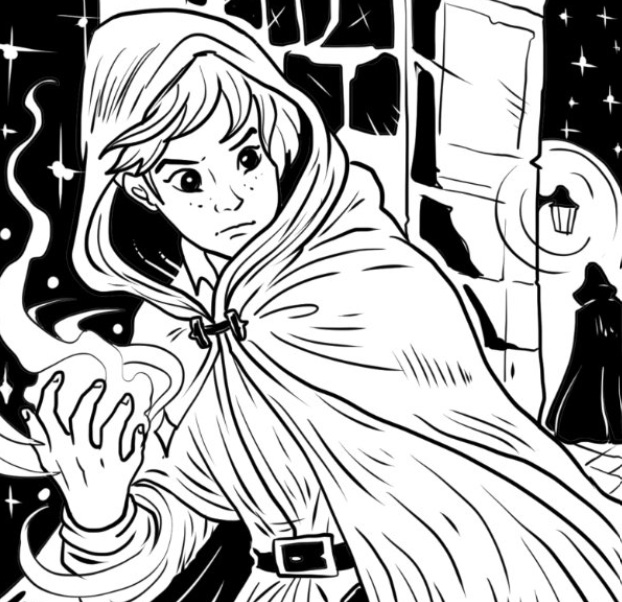
Wandering Familiar: This is the oddball class! Also, it’s not in the quickstart guide so you gotta get the full version to check it out. They’re not a student and can physically be any kind of animal that would fit the bill. There’s a roll table in case the player wants to randomly determine what kind of animal that they are. There’s a fairly freeform way to give them powers and they have a Beast Die that is fairly similar to mighty deeds.
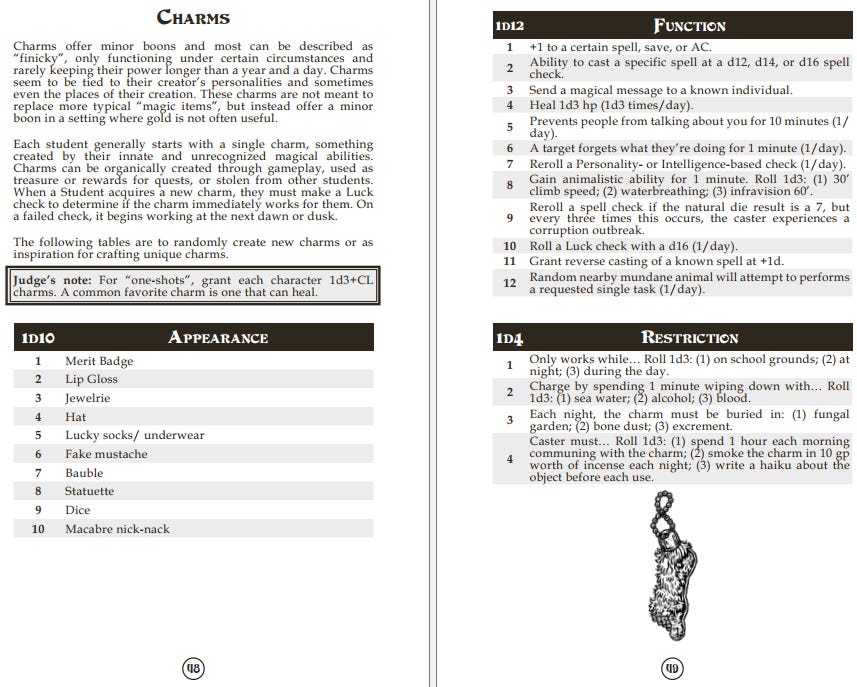
Charms: The PCs of Academia Arcana do not start as inherently powerful as DCC classes so a few magic items can help provide a little boost. Besides, a wizard school should have some magical bits and bobs laying around. There’s a generator for making more and a few already detailed out. They provide a minor benefit but generally have a restriction about when they can be used and must be recharged in some unusual manner.
Coven houses: The PCs ostensibly live in a kind of dorm room together, and perhaps with a few NPC too. Each player gets to make a d66 roll to see what notable rooms exist in their living space. This adds history, flavor, and opportunities for everyone to improvise.
Coven Casting Subcultures: DCC’s mercurial magic can be difficult for new players to keep track of. I’ve seen a lot of convention games where even experienced DCC players forgo mercurial magic that is printed on the spell sheets because the added level of complexity is just a bit too much when they’re already trying to figure out spells that they’ve never used before. So the idea of mercurial magic has been turned into “casting subcultures”. Similar to how cliques develop their own “in-jokes”, covens develop their own styles of spellcasting. The PCs can adopt one of these for themselves, or come up with their own way. It’s an optional rule that adds flavor when players are ready for a bit more.
Studying and Exams: It is set in school after all. So we’ve got some mechanics for attending class, studying, cheating, and taking tests. There’s benefits for doing good in school!
In Between Adventures: The purposes of this short section is to “bookend” adventures when it makes sense. The PCs may only have a couple big adventures each year, so what happened in between? It also can helps when one player misses a session and you want to explain why they weren’t around for the last adventure.
Ending Campaigns: This is brief section with prompts that the judge and players can use to create an “epilogue” where they talk about the end of school and where they go in life. I’ve used a really similar method in my home games and it works to help create a sense of closure at the end of a campaign.
Adventure Generation: I’ve filled the book with random tables for events that can happen in and outside of class, magical items, rumors, etc. Plus a few tables to generate NPCs (students and teachers) when you need that. There’s a nice page spread where all these are referenced (with page numbers and hyperlinks) so that you can easily refer to all these things and roll on them in an order that should provide a strong outline for an adventure.
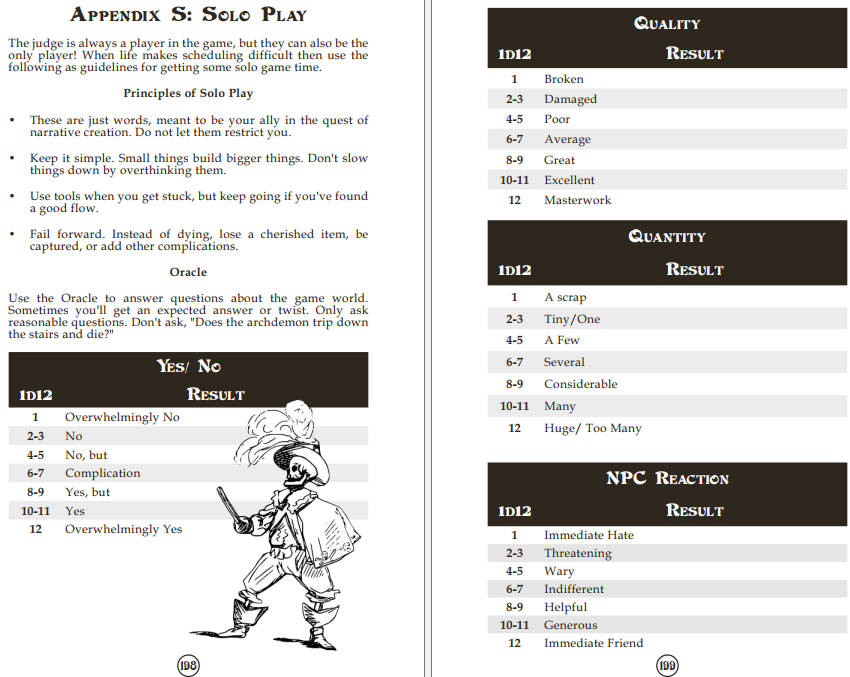
Solo Rules: This Oracle system (or substitute your own preferred one) will help solo players make their way through either fully written adventures or the previously mentioned Adventure Generator. This means the book can get some real use even when you can’t schedule a game with others.
Conclusion
That essentially does it for the new rules! Though Academia Arcana loads of new spells, monsters, students, and teachers too. I’ll go over the changes to existing DCC rules the next time I post about Academia Arcana. Hope y’all are interested in this game and follow it over on Backerkit. It’ll link you to the free Quickstart rules once you click the follow button.
Which part of Academia Arcana sounds most interesting to you?
What Else’s Happening?
The Sorcerer’s Conundrum
This puzzling level-2 adventure compatible with Dungeon Crawl Classics RPG will twist your noodle as you navigate a three-dimensional labyrinth filled with deadly challenges and confounding obstacles.